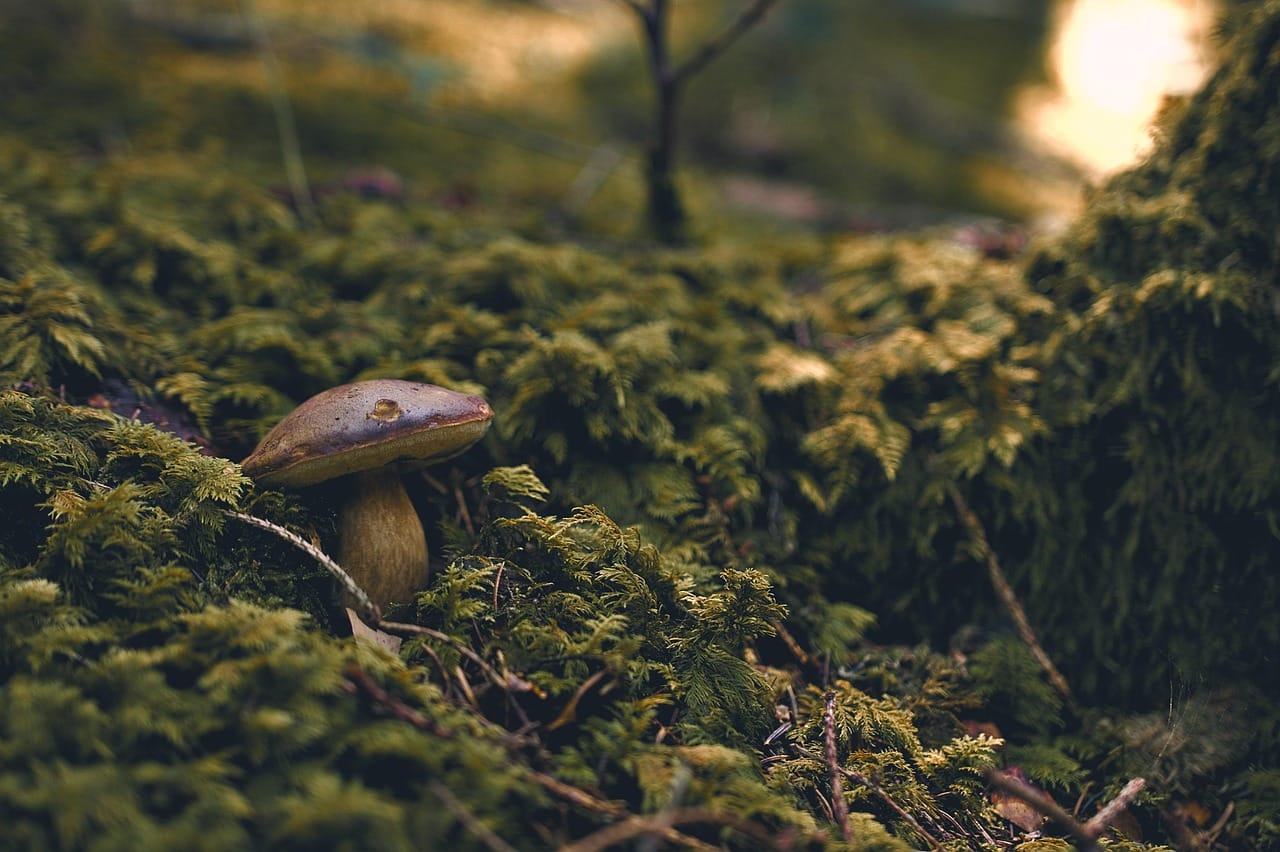
Not a love at the first sight
I did not fall in love with mushrooms because they were trendy. I fell in love with them because the more I learned, the more they quietly challenged everything I thought I knew about nature, intelligence, and connection and even mind and mental health. This love grow overtime and to be honest as a young girl I used to think mushrooms are disgusting. It took so much time and experience to change my approach and knowledge. So definitely it wasn’t a love at the first sight.
Recent scientific discoveries are only now catching up with what many cultures sensed intuitively for centuries. Fungi are not background organisms. They are architects of life, recyclers of worlds, and silent engineers beneath our feet (Literally – check out how Tokyo underground system has been designed!). Some mushrooms stretch for kilometres, some eat plastic, some survive radiation levels that kill almost everything else.
Once you start looking at mushrooms closely, it becomes hard not to wonder how much they might still change our future. And I find this fascinating.
The largest living organism on Earth
The largest living organism on Earth is not a whale or a tree. It is a fungus 🙂
In the forests of Oregon, scientists discovered Malheur National Forest to be home to a single individual of Armillaria ostoyae, often called the Humongous Fungus. This organism covers nearly ten square kilometres underground and is estimated to be thousands of years old. What we see above ground as separate mushrooms is actually ‘just’ the fruiting body. Beneath the soil lies an enormous mycelial network, one continuous organism sharing nutrients, information, and survival strategies across vast distances. This is almost mind-blowing to me. This discovery changed how scientists think about individuality, communication, and cooperation in nature. It also raised deeper questions. If a single organism can exist quietly for millennia, adapting and expanding without dominance or destruction, what other forms of intelligence might we be overlooking?
Mushrooms that eat plastic
In the Amazon rainforest, researchers discovered a fungus capable of breaking down plastic. The species Pestalotiopsis microspora can digest polyurethane, even in low oxygen environments. This means it can survive in landfills and underground where most organisms cannot. What makes this discovery remarkable is not just the environmental potential, but the timing. Plastic pollution is one of the greatest challenges of modern civilisation, and nature quietly offers a solution through an organism that has existed far longer than plastic itself. Scientists are now exploring how fungi could be used in waste management, biodegradation, and ecological restoration. For me this is a reminder that evolution often solves problems without noise, without urgency, and most importantly, without ego.
Mushrooms that survive radiation
Some fungi do not just survive radiation. They appear to thrive in it. After the Chernobyl nuclear disaster, scientists found dark pigmented fungi growing inside the reactor walls. Species such as Cladosporium sphaerospermum use melanin to absorb radiation and convert it into chemical energy, a process sometimes compared to photosynthesis. This phenomenon is called radiotrophy.
The implications are extraordinary. These fungi may one day help clean radioactive waste, protect astronauts from cosmic radiation, or inspire new materials designed to shield life in extreme environments.
Once again, fungi demonstrate an ability to adapt where life seems impossible!
From extraordinary fungi to everyday function
Not every mushroom grows for kilometres, eats plastic, or feeds on radiation. But all fungi share one thing. They evolved to interact deeply with their environment and to support balance, resilience, and communication.
Functional mushrooms are not extraordinary because they are exotic. They are extraordinary because they work quietly with the human body in much the same way fungi work within ecosystems.
As research grows, we are beginning to understand how compounds like beta glucans, polysaccharides, and apoptogenic molecules interact with immunity, stress response, and cognitive balance.
For me, functional mushrooms are a bridge between wonder and wellbeing. A way of bringing the intelligence of nature into daily ritual, not as a miracle cure, but as gentle support. Mushrooms do not rush. They grow, adapt, and support life in their own time.
And maybe that is exactly what we can learn and benefit from. With all our kindness and patience.