
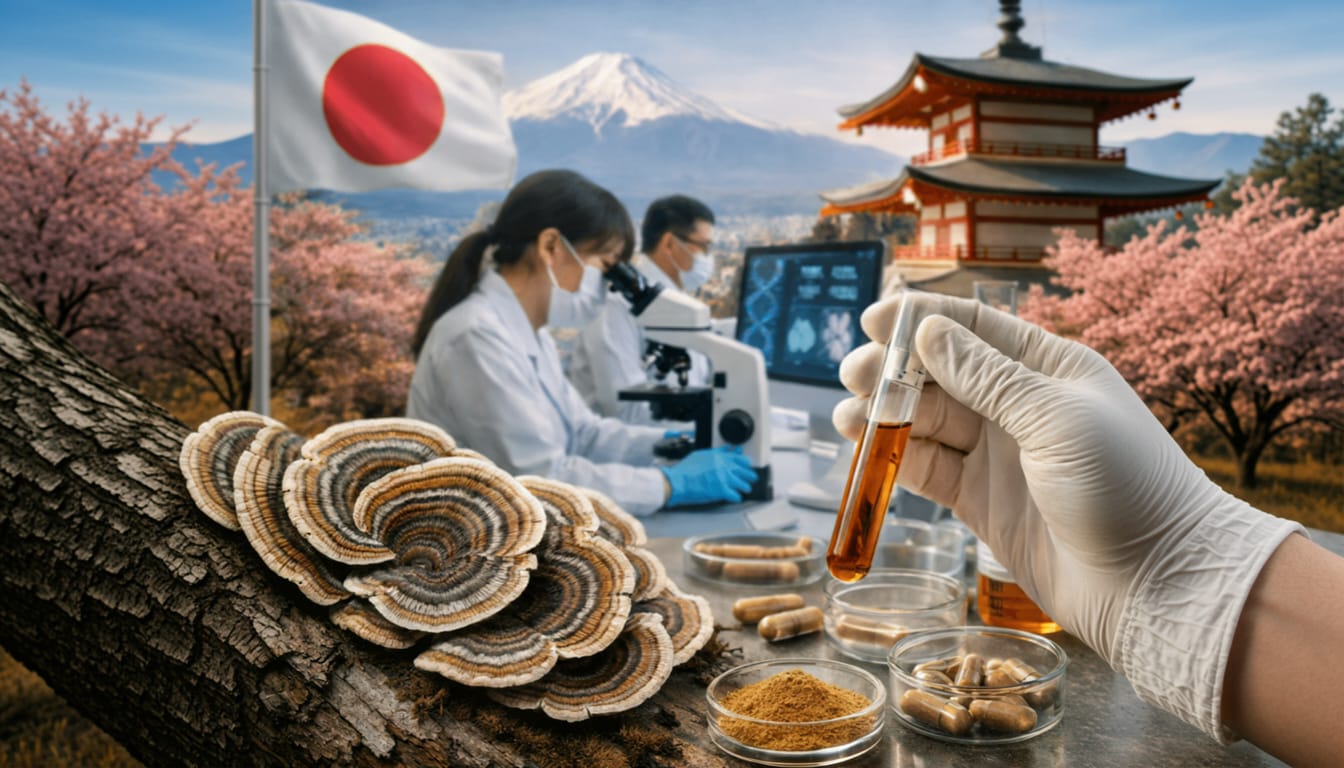
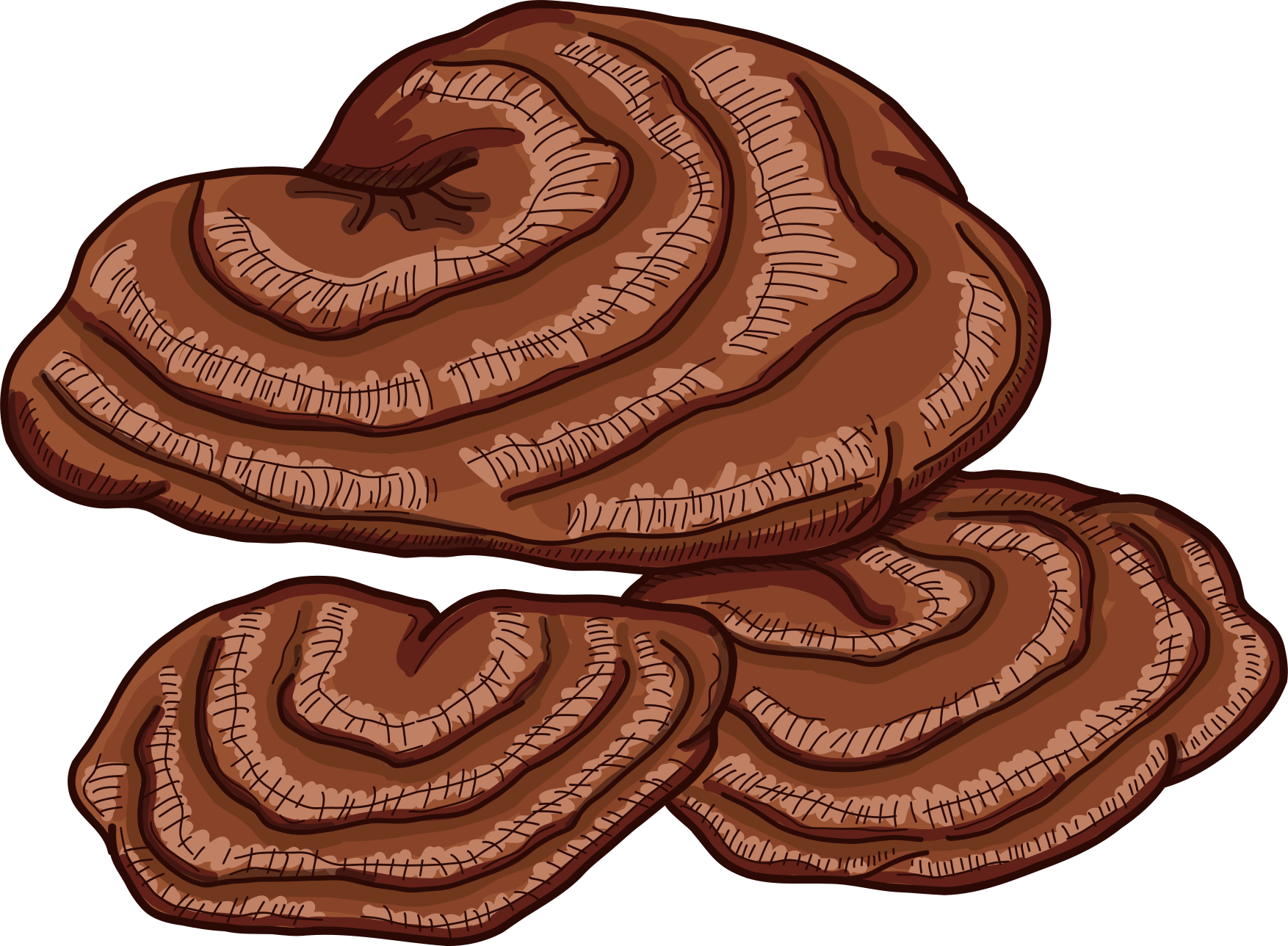
Among all medicinal mushrooms one species has gained an extraordinary level of scientific attention. Turkey tail, known scientifically as Trametes versicolor, is a thin fan shaped mushroom that grows on fallen trees across forests all over the world. Its name comes from the beautiful concentric rings on its surface that resemble the feathers of a wild turkey. At first glance it looks delicate and almost decorative, yet behind this simple appearance hides one of the most researched medicinal fungi on the planet.
In Japan researchers began studying turkey tail intensely during the second half of the twentieth century. Scientists isolated a complex compound from the mushroom known as PSK, or polysaccharide-K. This molecule is a protein bound polysaccharide rich in beta glucans which are known for their ability to influence immune activity. After years of research PSK was developed into a pharmaceutical medicine called Krestin and approved in Japan in 1977 as an adjuvant cancer therapy. An adjuvant therapy means it is not meant to replace treatments such as chemotherapy or surgery but rather to support the body during those treatments.
For decades PSK has been prescribed to cancer patients in Japan as part of clinical oncology protocols. It has been studied particularly in gastric cancer, colorectal cancer, lung cancer and breast cancer. Instead of directly attacking cancer cells like chemotherapy drugs, PSK works by interacting with the immune system. Research suggests that it can stimulate natural killer cells, T cells and other immune responses that help the body recognize abnormal cells. In this way turkey tail compounds act as what scientists call biological response modifiers. They support the body’s own defense systems rather than forcing a single targeted effect.
Japan is not the only country that has explored the medical potential of turkey tail. In China researchers developed another compound from the same mushroom known as PSP, or polysaccharide peptide. Although slightly different in structure, PSP is also derived from turkey tail and has been studied for its immune supporting properties. Both PSK and PSP belong to a fascinating category of mushroom derived compounds that combine complex sugars with proteins. These structures appear to interact with immune pathways in ways that scientists are still trying to fully understand.
What I find particularly interesting about the story of turkey tail is that it challenges how many people think about mushrooms. In many parts of the world mushrooms are still seen mainly as food or supplements. Yet in Japan compounds derived from this forest fungus have been integrated into mainstream medical treatment for decades. At one point PSK became one of the most widely prescribed anticancer drugs in Japan and represented a significant share of national spending on cancer therapies.
Of course it is important to understand the difference between pharmaceutical extracts and the supplements many of us use today. The PSK used in Japanese hospitals is a purified compound produced under pharmaceutical standards and prescribed by doctors. The turkey tail extracts available in health products are whole mushroom extracts that contain a range of natural compounds including beta glucans. While they come from the same species they are not the same thing. Still the research behind PSK has helped scientists understand how powerful the biology of mushrooms can be.
Turkey tail is also a reminder that fungi represent an enormous and still largely unexplored biological world. Scientists estimate that there may be millions of fungal species on Earth, yet only a small fraction have been studied in depth. Some fungi are now being explored for environmental technologies such as breaking down pollution or plastic. Others are being used to create sustainable materials including mushroom based leather. The more research is done the clearer it becomes that mushrooms are not simply ingredients in food or supplements. They are a vast natural library of chemical and biological innovation.
When I think about the future of mushrooms this is what excites me the most. Functional mushrooms are already helping many people support focus, immunity and overall wellbeing. But their potential goes far beyond wellness. From medicine to sustainable materials fungi may play an important role in how we rethink health, technology and our relationship with nature.
Turkey tail is a small quiet mushroom growing on fallen logs in forests around the world. Yet its journey from forest floor to hospital research labs shows just how remarkable the fungal kingdom can be. Sometimes the most unassuming organisms hold the most surprising possibilities.
1 Comment
Emka
April 3, 2026Such a good read. I love this kind of trivia because it reminds you how extraordinary fungi really are — some of the smallest and most hidden organisms, yet also connected to the largest living systems on Earth. When will humanity finally wake up to the true power and potential of mushrooms?